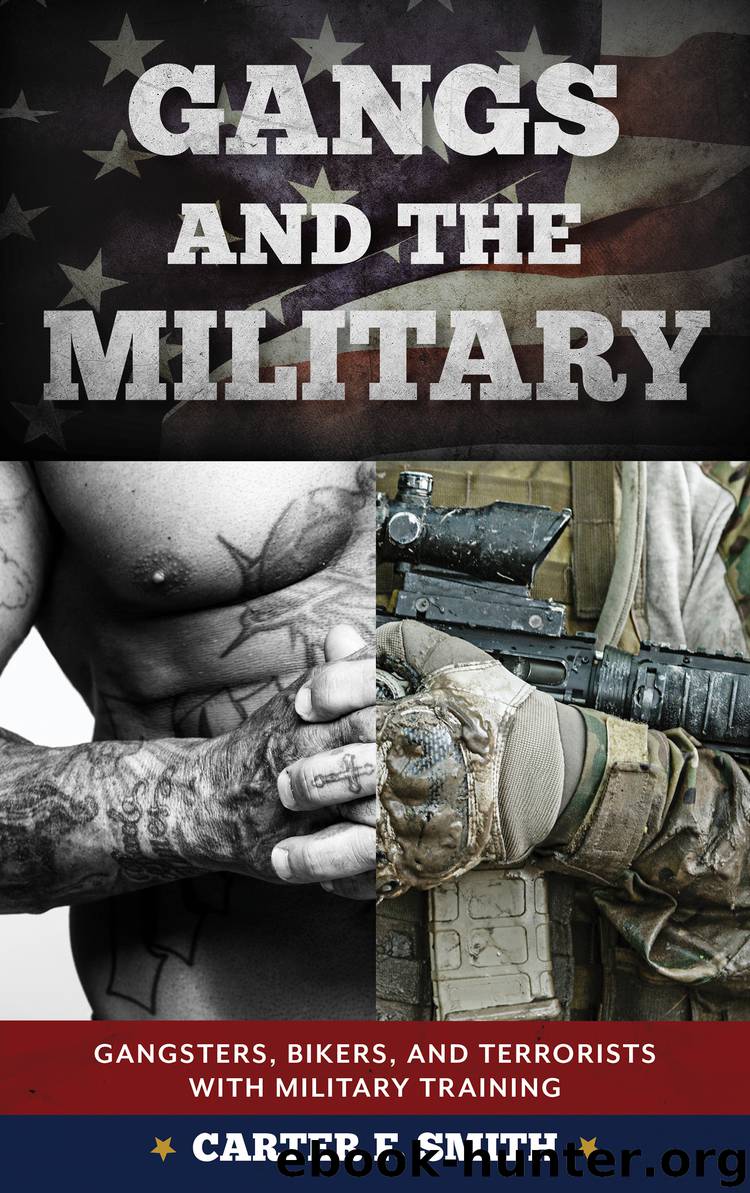
Gangs and the Military by Carter F. Smith
Author:Carter F. Smith [Smith, Carter F.]
Language: eng
Format: epub
Publisher: Rowman & Littlefield Publishers
Published: 2017-08-21T04:00:00+00:00
Many of the Army regulations had little guidance. Army Regulation 190-45 (Law Enforcement Reporting) defined a gang as: A group of individuals whose acts of crime are committed against the public at large as well as other groups. A gang usually has in common one or more of the following traits: geographic area of residence, race, or ethnic background. They have a defined hierarchy that controls the general activities of its members.11
Army policy on MP Investigations, Army Regulation 190-30 (2005) made one reference to gangs. In paragraph 4-2, it noted that MP Investigators were responsible for gang, or hate crime-related activity, when not within the investigative responsibilities of USACIDC.12 Likewise, Army Regulation 195-2, containing policy on Criminal Investigation Activities, made no mention of gangs.13
Army Regulation (AR) 600-20, until recently, had nothing directly about gangs, and now it has only a little. As we saw in the previous chapter, at the time of the Fort Bragg homicides there was no prohibition against gang membership of any sort by military service members. Both AR 600-20 and DoD Directive 1325.6 (later changed to DoD Instruction (DoDI) 1325.6—Guidelines for Handling Dissident and Protest Activities Among Members of the Armed Forces) prohibited active membership in extremist groups, and many leaders and investigators considered street gangs to be extremist groups, although neither of the documents specifically mentioned street gangs.14 When I say we considered them extremist groups, that was a consideration of necessity. It would have been nice to have a law that was current or workable, but in the absence of such a law, we got creative.
At the time the instruction was initially published as a Directive in 1969, the DoD was concerned with the infiltration of anti-war and anti-military organizations. The directive focused on dissident and protest activities within the military, and especially on activities such as underground newspapers, demonstrations involving military service members, and serviceman organizations. In 1986, the Secretary of Defense updated the directive with the first inclusion of anti-discriminatory language, trying to apply tools previously used to counter anti-war protest and unionization to now combat hate group membership. Dr. George Reed found that the timing of that change was right after the discovery of alleged participation of soldiers and marines from two military installations in North Carolina, Fort Bragg, and Camp Lejeune, in training activities of the White Patriot Party, the group headed by Frazier Glenn Miller, Jr.15
The directive’s language prohibited “active” participation in “extremist organizations.” That came from language in Executive Order (EO) 11,785 issued in 1953, during the height of the Cold War, when the government leaders feared Communist infiltration. It was later changed to forbid designating any groups as “totalitarian, fascist, Communist, or subversive” and forbade any circulation or publication of a list of such groups.
Department of the Army (DA) Pamphlet (PAM) 600-15 - Extremist Activities (2000) does not include the word gang anywhere in the document. The general guidelines included:
Modern extremist groups run the gamut from the politically astute and subtle to the openly violent. Their
Download
This site does not store any files on its server. We only index and link to content provided by other sites. Please contact the content providers to delete copyright contents if any and email us, we'll remove relevant links or contents immediately.
| Africa | Americas |
| Arctic & Antarctica | Asia |
| Australia & Oceania | Europe |
| Middle East | Russia |
| United States | World |
| Ancient Civilizations | Military |
| Historical Study & Educational Resources |
The Radium Girls by Kate Moore(12093)
100 Deadly Skills by Clint Emerson(4972)
Rise and Kill First by Ronen Bergman(4838)
The Templars by Dan Jones(4732)
The Doomsday Machine by Daniel Ellsberg(4545)
The Rape of Nanking by Iris Chang(4255)
Killing England by Bill O'Reilly(4042)
Stalin by Stephen Kotkin(4004)
Hitler in Los Angeles by Steven J. Ross(3978)
12 Strong by Doug Stanton(3575)
Hitler's Monsters by Eric Kurlander(3384)
The Code Book by Simon Singh(3250)
Blood and Sand by Alex Von Tunzelmann(3240)
Darkest Hour by Anthony McCarten(3161)
The Art of War Visualized by Jessica Hagy(3043)
Hitler's Flying Saucers: A Guide to German Flying Discs of the Second World War by Stevens Henry(2777)
Babylon's Ark by Lawrence Anthony(2718)
Tobruk by Peter Fitzsimons(2559)
The Second World Wars by Victor Davis Hanson(2554)
